Celebrating Success: A Year in Perspective at SCAS
It is that time of year to reflect on the previous 12 months and look towards the new year. 2025 has been an exciting year for SCAS, and we have big plans for 2026!
As a member-based charity, SCAS relies on the support of its members and is grateful for the hard work and dedication of all the volunteers who serve on the Board of Trustees, SCAS Working Groups, and the Communications Team: https://www.scas.org.uk/teams
Message from SCAS Chair, Dr. Elizabeth Ormerod:
“On behalf of the SCAS Board, I wish to express our profound gratitude to all volunteers and supporters whose dedication has been instrumental in advancing the mission of SCAS. Together, we have established SCAS as a leading organization at the forefront of research into human-animal relationships, generating insights that inform both academic discourse and practical interventions to enhance the well-being of people and animals, particularly among vulnerable populations. We are very appreciative of the Communications Team whose work in updating the website and SCAS branding has been transformative. Their key role in disseminating information about human- animal interactions cannot be overstated.
We very much welcome the increasing number of volunteers contributing to our Working Groups, whose collaborative efforts have enriched our research agenda and expanded the scope of our scholarly activities. As we look ahead to 2026, we anticipate significant developments in the field of human-animal interactions. Please invite colleagues from practice and academia, who are not yet members to join us in this dynamic and interdisciplinary journey. Your expertise and engagement are vital as we strive to foster evidence-based practices and advance knowledge for the benefit of society and animal welfare. Thank you all, most sincerely, for your commitment to research excellence and collaborative progress.” - Elizabeth Ormerod (on behalf of the SCAS Board of Trustees).
SCAS President, Emeritus Professor James Serpell
As the year draws to a close, SCAS is delighted to welcome Emeritus Professor James Serpell as our president!
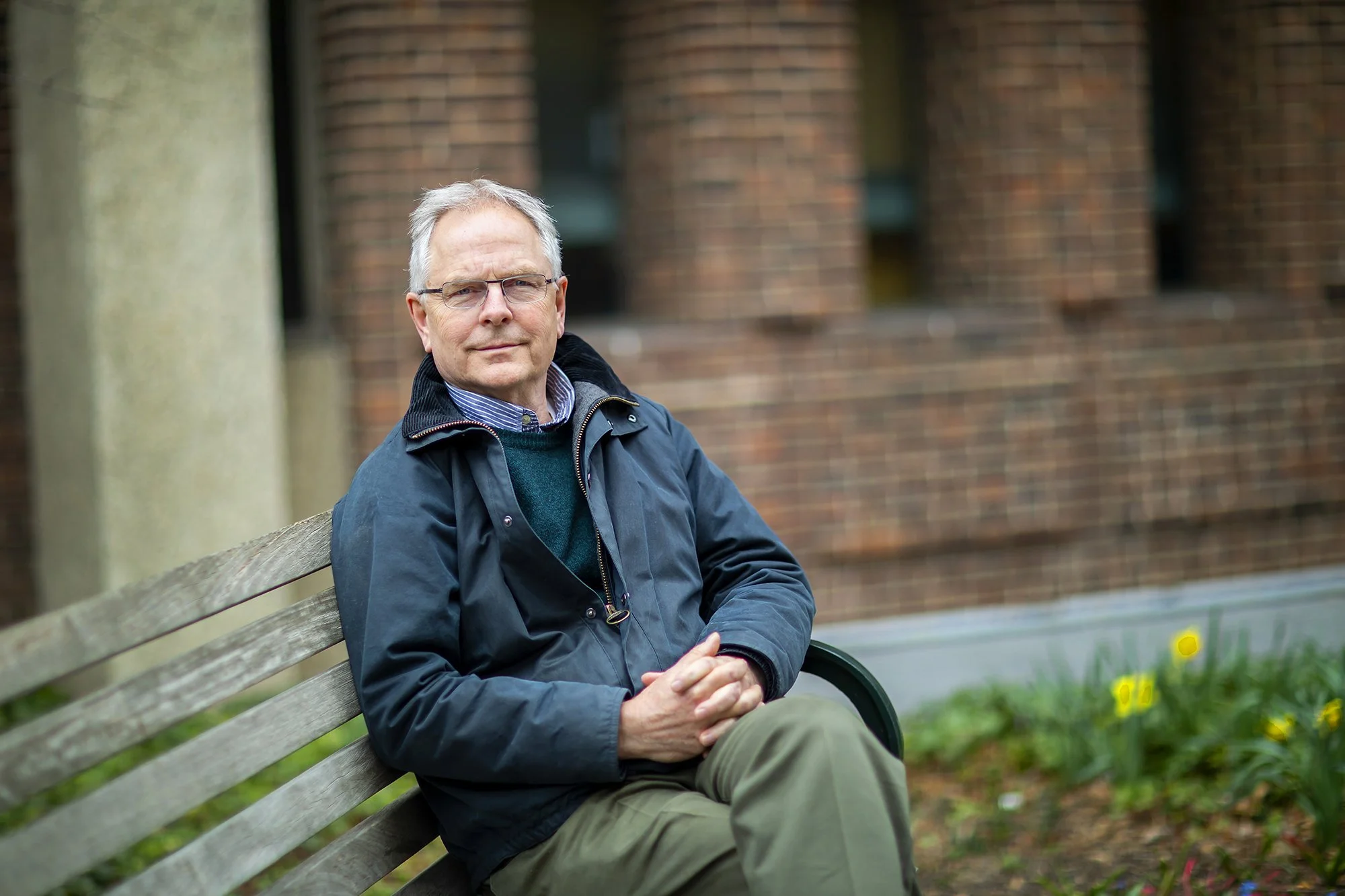
James Serpell is Emeritus Professor of Animal Welfare at the School of Veterinary Medicine, University of Pennsylvania. He received his BSc degree in Zoology from University College London, and his PhD in Animal Behaviour from the University of Liverpool, UK. His research focuses on the behaviour and welfare of dogs and cats, human attitudes to animals, and the history and psychology of human-animal relationships and interactions. He has published more than 200 articles and book chapters on these and related topics, and is the author, editor, or co-editor of several books including Animals & Human Society: Changing Perspectives (1994), In the Company of Animals (1996), Companion Animals & Us (2000), and The Domestic Dog (2016). In 2003, he created the C-BARQ—currently the world’s most widely used canine behavioural assessment instrument (http://www.cbarq.org), and, many years before that, helped to establish both the Society for Companion Animal Studies (SCAS) and the International Society for Anthrozoology (ISAZ).
The Annual SCAS Conference
The 2025 SCAS Virtual Conference, “Unified Voices: Why the Human-Animal Bond is Important to You as Professionals,” was an inspiring event that brought together experts and practitioners from across disciplines. Held on Sunday, 19 October, the conference explored the profound ways the human-animal bond shapes professional practice and wellbeing. Read more…
A recording of the conference is available for purchase. Join SCAS now and purchase at the reduced rate! Contact info@scas.org.uk to request a copy of the SCAS 2025 conference (or any of the previous 5 conferences).
Kudos to Barbara Cooper and her Conference Working Group, Victoria Turner, our Comms Team and all our speakers. Many thanks to the College of Animal Welfare for hosting the conference, and to VetSkill whose sponsorship for SCAS conferences is invaluable and deeply appreciated.
2026 SCAS Virtual Conference
Don’t forget to mark your calendars for next year’s event on Sunday, 18th October 2026. We look forward to seeing you there!
Members were asked for feedback on their preferred themes for the 2026 SCAS Conference, and the chosen focus will be announced early next year.
SCAS Webinars
Missed a Webinar? All 2025 webinar recordings can be purchased for £5 each. Please email info@scas.org.uk
Anita Franklin, PhD Candidate, Flinders University. Unhousing the Norm: Disability, Pets, and the Politics of Home.
Dr. Roxanne Hawkins, Director of the Human–Animal Research Group, University of Edinburgh. The Complex Interplay between the Human-Animal Bond, Perinatal Mental Health, and Companion Animal Welfare
Dr. James Serpell, University of Pennsylvania, USA. Ethology by Proxy: Using Citizen Science to Study Dog Behaviour.
Phil Arkow, National Link Coalition, USA. The ‘Dark Side’ of the Human-Animal Bond: Animal Abuse, Human Violence, and its Significance for Human-Animal Interactions.
Dr. Daniel Mills, University of Lincoln. Relationships and the Dog-Owner Bond – A Psychobiological Perspective.
Dr. Carri Westgarth, University of Liverpool. The challenge of “Just Old Age” & development of the Ageing Canine Toolkit.
The ‘Old Age Pets research project’ was funded by BSAVA PetSavers and resulted in the Ageing Canine Toolkit (ACT). The ACT includes a traffic light colour coded checklist for owners, along with a leaflet containing information that ties in with the checklist topics. This SCAS Webinar is free for anyone to watch: https://www.youtube.com/watch?v=SElOJC5mPEs
Carri Westgarth and Sarah Williams also wrote a blog for SCAS on ‘Guiding better care for senior dogs: how the Ageing Canine Toolkit helps owners navigate senior dog health with their veterinary professionals.’
Jade Statt, StreetVet, UK. StreetVet – Protecting the Human-Animal Bond.
Shirin Dhabhar, Founder of Canines Can Care, India. How Religious and Cultural Influences Shape Canine Behaviour Work in India.
Dr Anindita Bhadra, Indian Institute of Science Education and Research Kolkata, India. Dogs and Humans, A Story of Coexistence.
SCAS webinars include a formal presentation followed by live questions and answers with the presenter. They are recorded and available to all registered participants, including those who could not attend live. Registration via Eventbrite is required but is free for SCAS members (become a member now) and for a small fee to non-members.
2026 Webinar line up (UK times given; recordings available):
We are very excited to announce the complete line up of webinars for 2026. Get these dates in your new diaries now!
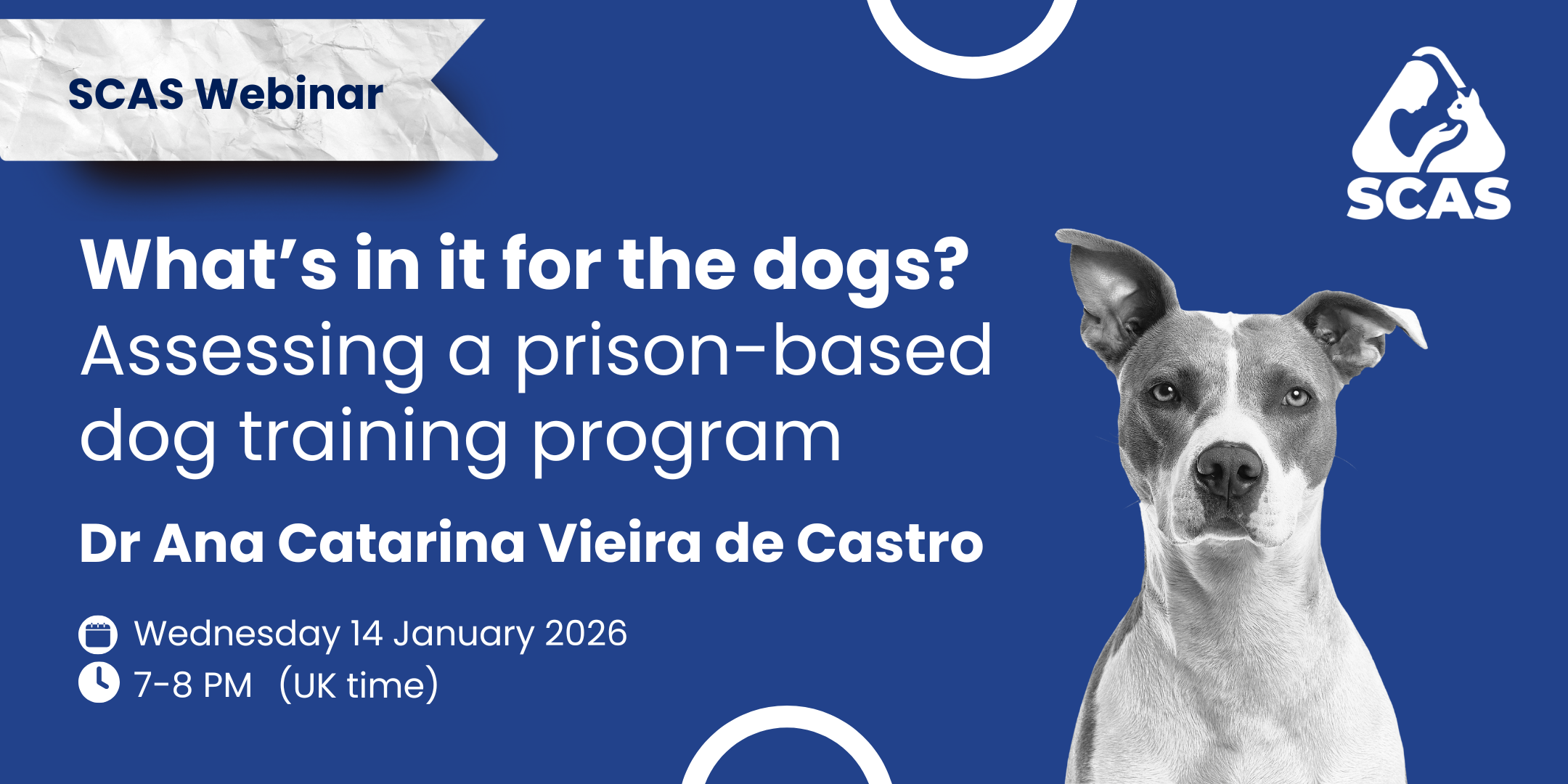
2.
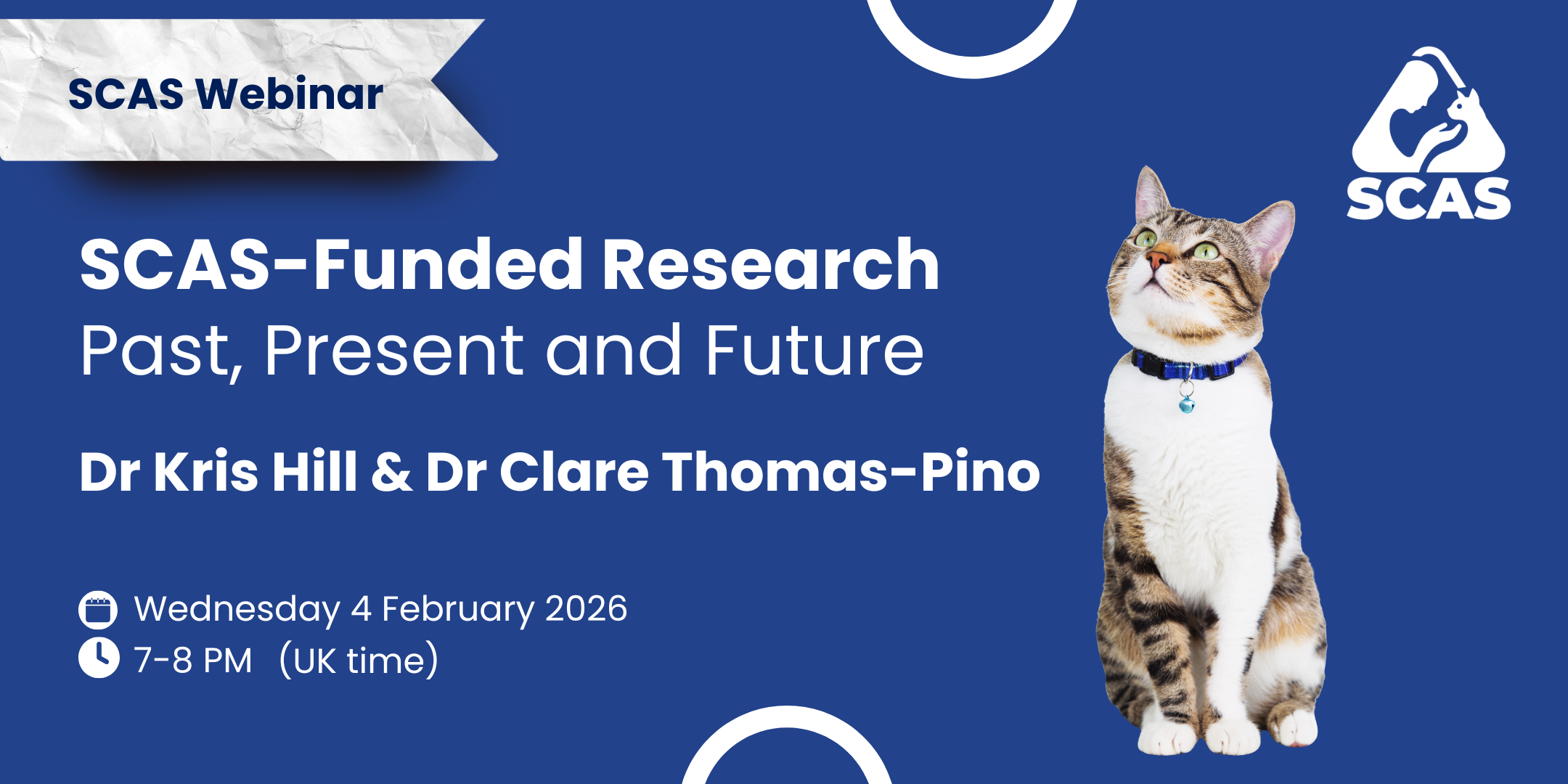
3.
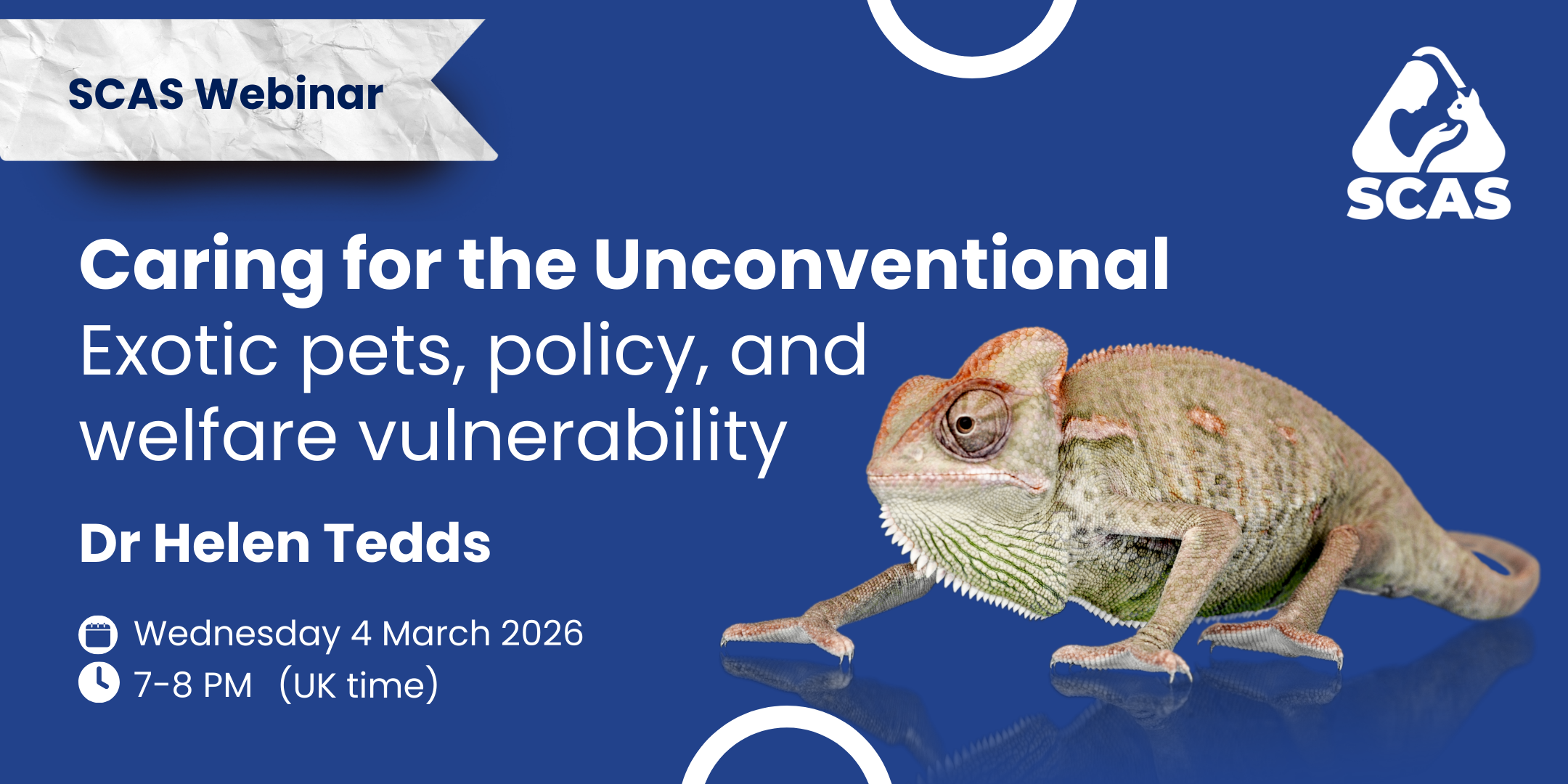
4. Wed 8th April 2026, 7-8 pm: Holly Dalby, Pets in Housing gap analysis.
5. Wed 6th May 2026, 7-8 pm: Dr. Carol Tinga, Companion Rabbits: Scientific Insights into Behaviour, Welfare, and the Owner–Rabbit Relations.
6. Wed 3rd June 2026, 7-8 pm: Dr. Emily Kieson, Wild horses in Scotland and Nepal.
7. Wed 8th July 2026, 7-8 pm: Nancy Parish Plass, on her Animal-Assisted Services work.
8. Wed 2nd Sept 2026, 7-8 pm: Dr. Ross Barker, Pet-Inclusive Housing, Michelson Found Animals.
9. Wed 7th Oct 2026, 7-8 pm: Dr. Steve Dale, A new approach to managing dog bites.
10. Wed 4th Nov 2026, 7-8 pm: Dr. Emily Bray, Puppy development of behaviour and cognition.
SCAS-Funded Research
The human-animal bond is a mutually beneficial and dynamic relationship between people and animals that is influenced by behaviours that are essential to the health and wellbeing of both. However, research is fundamental to ensuring evidence-based good practices and to best support human and animal wellbeing. From its founding, SCAS has endeavoured to provide funding for original research that aligns with our aims.
Since 2020, The Society for Companion Animal Studies (SCAS) has awarded four annual rounds of funding to support research which furthers the current understanding of the human-animal bond. Read more…
Here are some recent outputs from SCAS-funded research:
SCAS-funded research from a 2022 pump-priming grant, awarded to Danielle Stephens-Lewis, was published this year in a peer-reviewed journal (open access):
Foster, J., Stephens-Lewis, D., & Schenke, K. C. (2025). Profiling hypermobile Ehlers-Danlos syndrome (hEDS): factors in health and wellbeing with chronic conditions and opportunities for improving self-management. Disability and Rehabilitation, 47(18), 4716–4727. https://doi.org/10.1080/09638288.2025.2458187
The SAFEpet@home Toolkit, supported by a 2024 pump-priming grant awarded to Peter Reniers, was recently published. This complements the SAFEpet@facility Toolkit, which was supported by a 2020 pump-priming grant awarded to Janette Young. Both can be downloaded free of charge from our website.
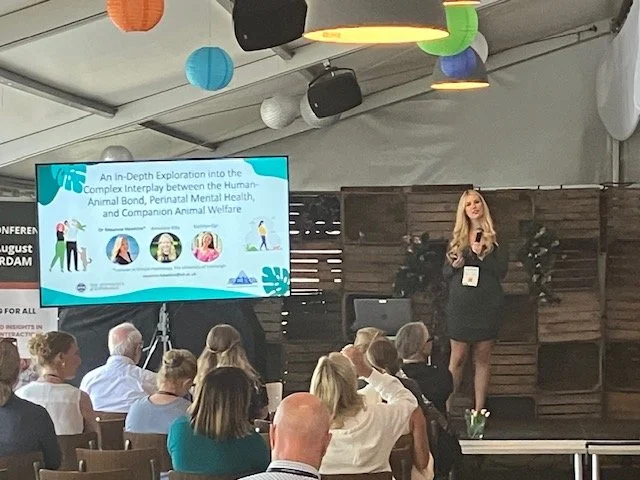
In a recent SCAS Webinar, Roxanne Hawkins shared key findings from her 2024 SCAS Funded Project on the complex interplay between the human-animal bond, perinatal mental health, and companion animal welfare. Roxanne also shared research findings from the project at the IAHAIO Conference in Amsterdam (23-24 August). This important research is anticipated to be published in a peer-reviewed journal in the near future and ultimately translated into a resource that can be used to provide much needed information to expectant and new mothers.
Dr. Roxanne Hawkins pictured presenting SCAS-funded research on the human-animal bond, perinatal mental health, and companion animal welfare.
Michelle Szydlowski presented preliminary findings from their 2024 SCAS Funded Project, ‘Cats and Dogs in Nepal: A New Frontier’, at the Living With Animals Conference held at Eastern Kentucky University, USA, 13-15 March, 2025. Kris Hill, a co-Investigator on the project also presented an update at the IAHAIO Conference in Amsterdam (23-24 August). Sarah Oxley Heaney, wrote a reflective blog on her fieldwork experiences in Nepal while collecting data for this same project, “Reflections on Cats, Dogs and a Multispecies Community: Bonded Coexistence in Sauraha’s Sharing Society.” Read more here…
Showcasing SCAS funded research impacts
Together with the Communications Team, the Research Working Group (RWG) are putting together a pamphlet to showcase research and outputs supported by SCAS.
Have you ever received SCAS funding? If you have received SCAS funding, recently or historically, we would love an update on the impact this research had on the field and/or to careers - please share with us any direct or indirect outputs, such as how a pump priming award helped secure ongoing funding, or has been translated into practice. The RWG email is: research@scas.org.uk
New research funding programme from SCAS for 2026
The next call for applications for SCAS funding research is anticipated to open February 2026, and close May 2026.
Register for the SCAS Webinar on “SCAS-Funded Research: Past, Present, and Future” (Wed 4th Feb 2026, 7-8 pm - recordings available) to learn more about the aims of SCAS and the type of research we seek to support.
Our website also includes links to other funding bodies who support human-animal interaction research and programmes. Read more…
SCAS in Parliament
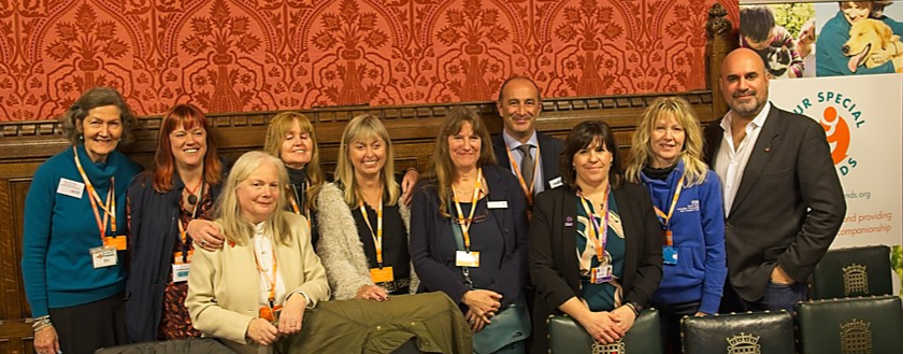
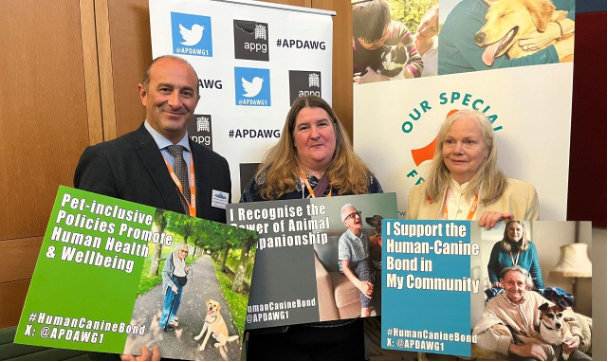
In January 2025, SCAS and Our Special Friends (OSF), had the opportunity to co-host an event at the Palace of Westminster. Dr Marc Abraham OBE, who provides the Secretariat of the All-party Dog Advisory Welfare Group (APDAWG) invited SCAS and OSF to deliver presentations on the ‘Power of the Human-Canine Bond’. We are very grateful to Marc Abraham for this opportunity.
SCAS speakers with Dr Marc Abraham OBE
SCAS provided a brief statement with recommendations to MPs
The human-animal bond is an important area of public health. It can be applied to create Animal Assisted Services (AAS) programmes, low-cost interventions which enhance human health and quality of life and improve animal welfare. These can be tailored to support any vulnerable group or facility.
Animal Assisted Services must be carefully planned with a transdisciplinary approach. The SCAS Code of Practice provides guidance to help ensure effectiveness, sustainability and welfare of all involved.
Pet owners, across lifespan, derive a range of documented health benefits and much social support from animal companionship. The presence of dogs and cats in communities creates social capital – friendlier, safer communities.
The teaching of humane education encourages respect for others – other people, animals and our environment, and is documented to promote prosocial behaviour.
SCAS Recommends
Training of the professions about the human-animal bond, and its applications to their work.
The introduction of humane education to schools, colleges and prisons.
Legislation for pet inclusive housing. Many people are currently denied the benefits of a human-animal bond due to pet bans in housing.
Greater implementation and regulation of Animal Assisted Services. These should be a normal feature of institutions.
The event concluded with presentations about the SCAS Code of Practice in Animal Assisted Services by Dr Elizabeth Ormerod, SCAS Chairman, and Dr Evangelis Diamantakos, SCAS Trustee. They emphasised the role of the SCAS Code in helping to ensure safe practice for all. The Code is currently being updated and endorsement from professional bodies will be sought for the new version.
Vangelis Dianatakos, Clare Thomas-Pino and Elizabeth Ornerod at Portcullis House
SCAS Code of Practice in Animal Assisted Services
The SCAS Code of Practice in Animal Assisted Services (formerly Animal Assisted Interventions) is a living document that is being updated to reflect language changes and recent research.
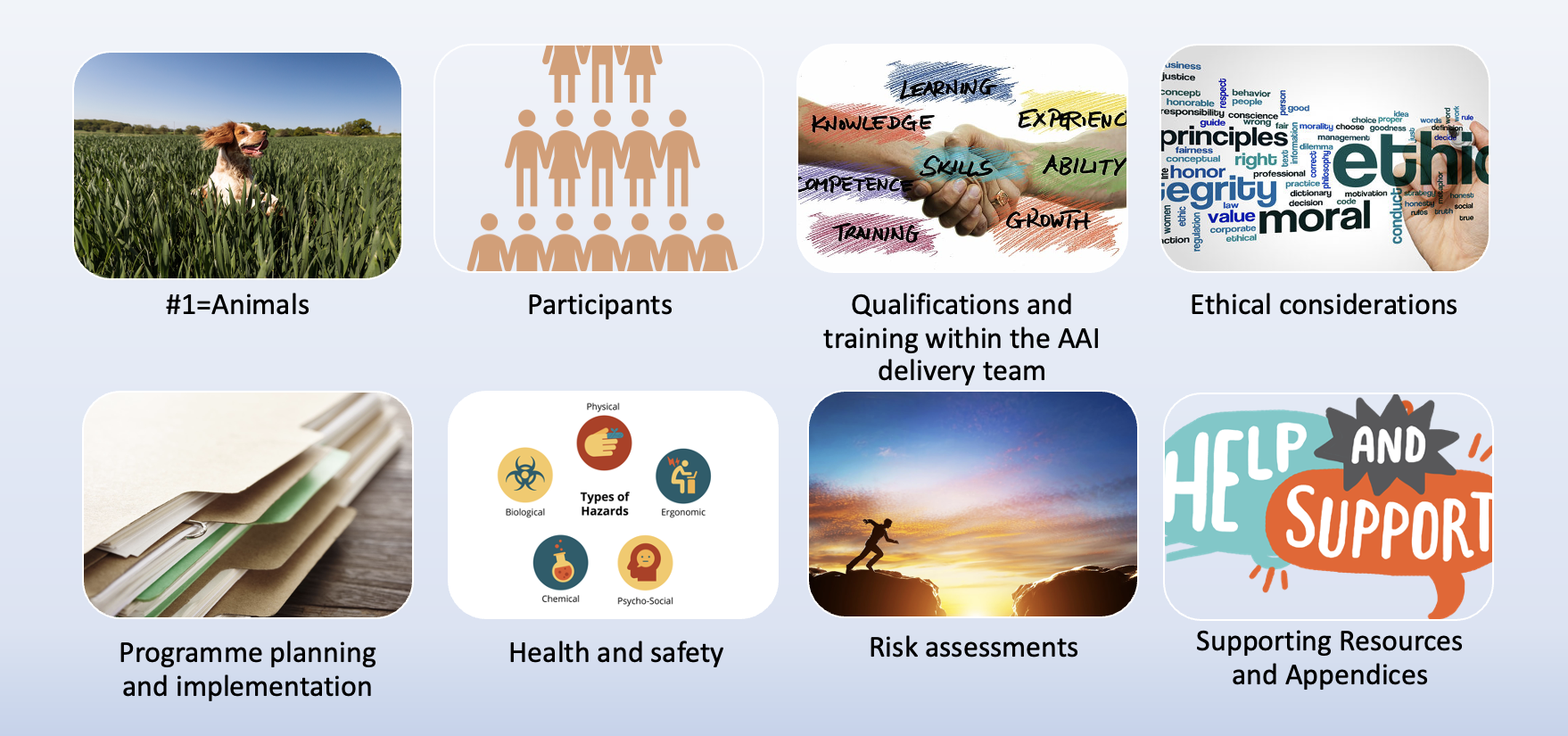
The Animal Assisted Services/Education Working Group (AAS/ED WG) is expanding, with members from practice and academia. A current major task of the working group is an update of the SCAS Code of Practice in AAS. Your input has been sought for this important document in the burgeoning field of AAS. The SCAS Code is designed to help ensure safe practice for all involved.
SCAS Code of Practice covers ALL these areas (animals 1st):
Pets and Housing
SCAS is dedicated to easing the burden of finding suitable pet-friendly accommodation, striving to help responsible pet owners and their beloved pets live happily together through research and advocacy.
The Society for Companion Animal Studies (SCAS) welcomes the Housing Bill Scotland and the Renters' Rights Bill (England) as a significant milestone in tenant protection and wellbeing. As the UK’s leading voice on the human-animal bond for over four decades, SCAS is encouraged by the Bill’s recognition of tenants’ rights to keep companion animals. Read more...
Working in Partnership
The Bob Harvey Award
SCAS continues to partner with Lesley Winton, CEO of Fostering Compassion and past SCAS Trustee, on The Bob Harvey Award. This award is for organisations such as care homes that have demonstrated commitment to keeping people and their pets together in supported living settings.
Picture of Bob & Darcie

In memory of Bob (pictured above with his little dog Darcie), The Bob Harvey Award will be presented to a care home, hospice, hospital or care facility that has gone above and beyond the call of duty to keep human and animal together and protect that all important bond.
Applications are being accepted until 31 March 2026. Please alert colleagues working in health and social care to this award. Download forms here: https://www.scas.org.uk/awards
Canine Partners at Windsor Castle
In October our Chairman, Dr Elizabeth Ormerod, was invited to Windsor Castle to deliver an address on the occasion of the 35th Anniversary of Canine Partners, which she co-founded.
Dr Elizabeth Ormerod delivering a keynote at Windsor Castle:
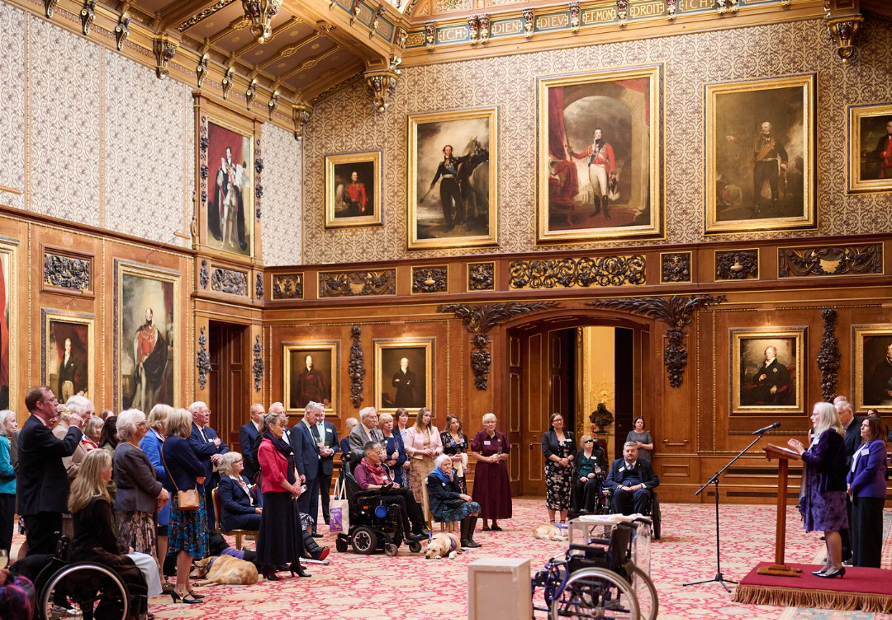
During her address she explained that SCAS plays a key role in the development of Animal Assisted Services (AAS) and assistance dog programmes. Its interdisciplinary membership facilitates synergistic collaboration on projects that improve the lives of people and animals.
The International Association for Human Animal Interaction Organisations (IAHAIO) Conference in Amsterdam (23-24 August) was a great success, and it was wonderful to see so many SCAS members present their work to colleagues.
Picture left to right: Selina Gibsone, Tracie Faa-Thompson , Clare Thomas-Pino, Kris Hill, Elizabeth Ormerod, Roxanne Hawkins, Helen Lewis, and Steve Wibberley.
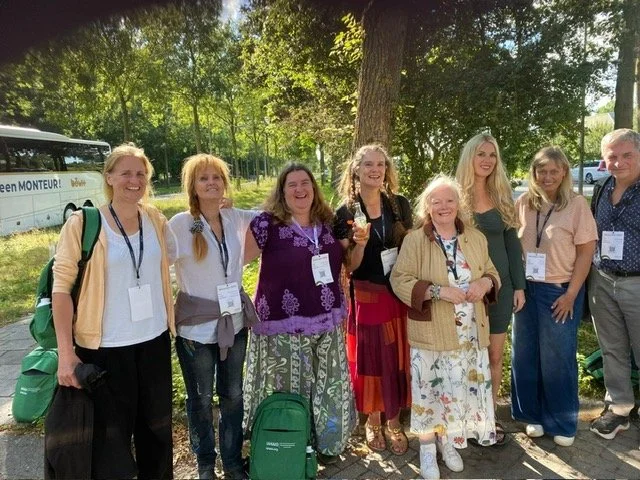
IAHAIO was founded in Canada in1991, and SCAS was one of 7 founding members (read more here). As a member of SCAS, you qualify for the reduced registration fees for IAHAIO conferences and other benefits of IAHAIO membership.
National Pet Month was another huge success and SCAS was delighted to be part of celebrating the special bond between people and pets, contributing several articles to the campaign. #NPM
The Science of Companionship: Why Pets Make Our Lives Better. By Parizad Baria-
Unwalla. Read article here…
Pet-Friendly Housing: Ensuring pets have a place in our homes. By Sandra McCune. Read article here…
Coping with Pet Loss: Finding Support When You Need it Most. By Elizabeth Omerod. Read article here…
For Loneliness Awareness Week, 9-15 June 2025, SCAS member Dr. Lori Hoy wrote an article for Loneliness Awareness Week: ‘Pets and the Power of Connection’. Read more...
For International Cat Day, 8 August 2025, SCAS member Neha Arora wrote about her lived experiences with her cat in different parts of the world: ‘Claws, Contracts, and Cuddles: Travelling the World with a Cat’. Read more…
International Human Animal Bond (IHAB) Day is held every year on 8th November. This dedicated day recognises, highlights and celebrates our animal companions and the wonderful relationships we can build with them. Originally, founded through a joint effort in 2021 between the Society of Companion Animal Studies in the United Kingdom and the Human Animal Bond Association in the United States, it’s a special moment to advocate for greater recognition of the bond, for more opportunities for people and animals to benefit from a bond relationship, and for greater implementation of animal care and welfare education and for training of the professions about their role in human-animal interactions.

This year SCAS celebrated Human–Animal Bond Day by applauding progress in new housing rights for pet owners. Read more…
New Look! New Website!
Earlier this year, we were delighted to announce the launch of a brand new logo and website.
This marked our first major update in over a decade and reflects our aspirations to engage with a wider audience, stay relevant in a changing landscape, and more effectively promote research and evidence-based practice.
The refreshed brand and new website aim to better communicate our core values and provide an accessible, user-friendly experience for our diverse audience. The new website features improved navigation, reliability, mobile responsiveness, and easier access to research, resources, and membership information. In addition, the site benefits from a cleaner look, more readable font, and more inclusive imagery that better reflects contemporary UK society.
“The Comms Team has excelled in the creation of the superb new website, masterminded by Communications Officer Parizad Baria-Unwalla, with content contributed by the team. We are very grateful for essential IT support from the College of Animal Welfare to facilitate the transfer from the old to the new website. The refresh of the SCAS brand is truly wonderful and was organised and overseen by Communications Officer Dr Émilie Crossley” (Dr. Elizabeth Ormerod, SCAS Chair).
Introducing our New Communications Team Members
Earlier this year, the SCAS Communications Team recruited two new Volunteer Communication Officers, Neha Arora and Judith Billingham.
The Communications Team now consists of 8 dedicated members: Dr. Sandra McCune (Chair), Dr. Kris Hill, Dr. Émilie Crossley, Parizad Baria-Unwalla, Dr. Elizabeth Ormerod, Victoria Turner, Neha Arora and Judith Billingham.
We are also grateful to our Communications Volunteers, Dr. Lori Hoy, Anita Franklin and Raghad Hussein, who are available to assist on specific tasks or writing projects.
Neha Arora
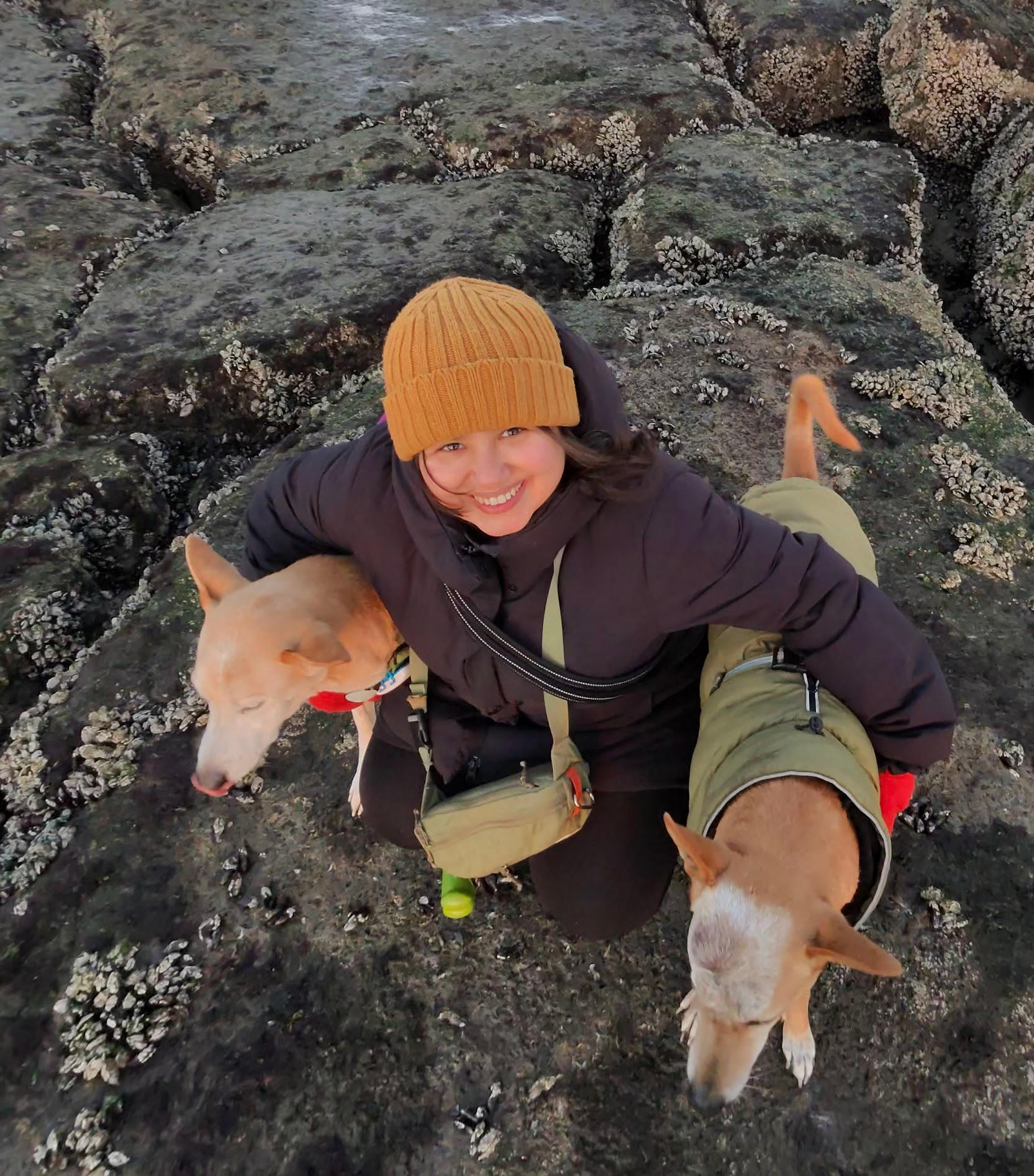
Neha is a second-year PhD student at the University of Oxford, exploring how UK-based truck drivers care for and travel with their companion animals. Before returning to academia, she worked in PR and communications across banking and the wind energy sector. At home, her research assistant team consists of two Indian Pariah dogs (Champu and Jebo) and Shiro, a Mongolian cat, none of whom respect office hours.
Judith Billingham
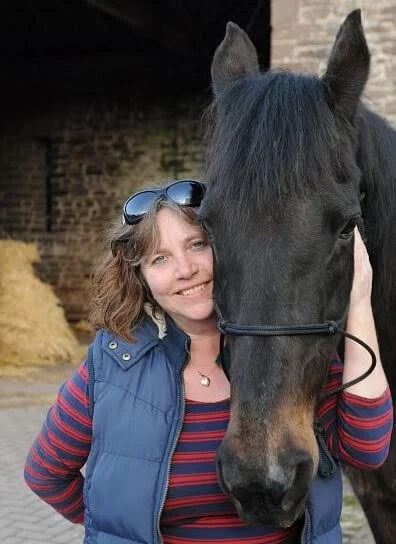
Judith is a qualified play therapist and trauma-informed mental health practitioner, and Founder of InCahoots TLC. Read more here…
Looking Forward to 2026!
2025 has been a busy year at SCAS. The charity continues to be relevant and impactful as the leading voice on Human-Animal Interaction in the UK. We finish the year with energised and productive teams, a new President, and a fresh new look, ready for another exciting year ahead. We hope you will be a part of the SCAS journey in the coming year.
SCAS Annual General Meeting (AGM)
The next SCAS AGM will be held on Wednesday 21 January 2026, 7.30-8.30 pm UK time (Online)
All SCAS members are invited to attend and a Zoom link and copy of the minutes will be shared with members.
Get Involved!
As a member-based charity, SCAS relies on the support of its members.
You can get involved at different levels of commitment and share your ideas, expertise and skills, as well as learning new skills.
To express your interest in joining one of the SCAS working groups (Conference, ASS/Education, or Research), please send your CV and short cover letter to info@scas.org.uk explaining which working group you are interested in.
You are also encouraged to register as a Communications Volunteer with the SCAS Communications Team by filling out this form.
As part of the SCAS Communications Strategy, we are looking for people with varied communications skills. These include blog writing, summarising scientific articles for a lay audience, planning and coordinating webinars, creating engaging graphics for social media and website posts, collating the quarterly newsletter, website management, social media management, membership campaigns and more. If you have one or more of these skills, are aligned with our aims, and would like to contribute (and be acknowledged) to our work at SCAS, please apply. Positions are flexible, depending on the role chosen and your availability. It can be as little as 4 hours a month, to as much as 4 hours a week.
Follow us on Social Media and Bookmark our Website
We regularly share relevant news, Human-Animal Interaction vacancies, and funding opportunities on our social media platforms (X @SCASuk, Facebook, LinkedIn, and BlueSky) and share SCAS-authored content on our Website (see SCAS Blogs).