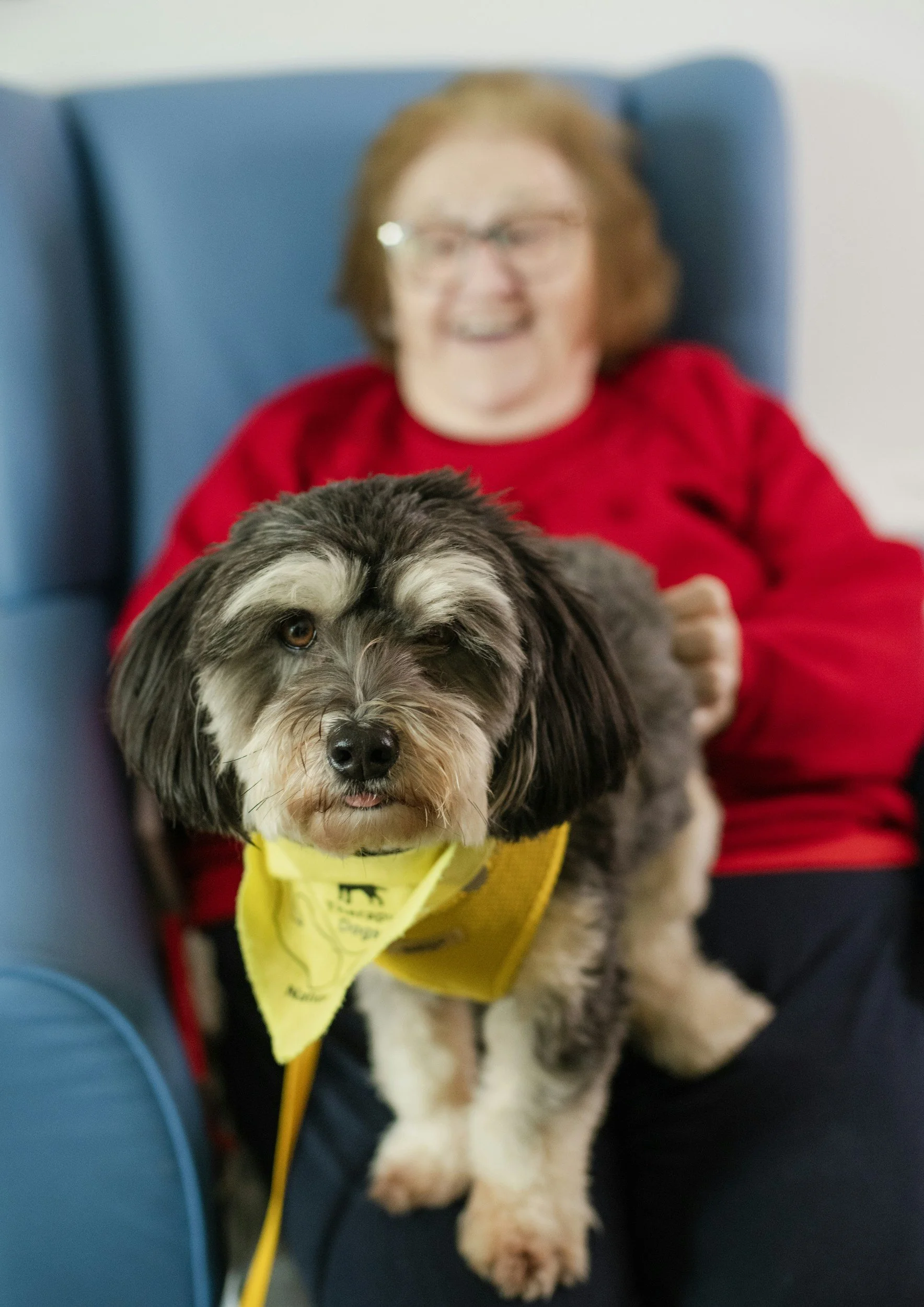
What does it really take to prepare and support a therapy dog?
By SCAS Communications Officer, Judith Billingham
A new paper, “Preparing Therapy Dogs for Animal-Assisted Services: Governance, Welfare-Centred Preparation, and a Lifecycle Research Agenda Across Selected European and United States Frameworks”, explores this important question.
Written by Muhzina Shajid Pyari, Kun Guo and Niko Kargas, the review examines how therapy dogs are selected, trained, assessed and supported throughout their working lives.
Dogs are increasingly involved in healthcare, education, social care and community services. However, the systems designed to prepare and protect them vary considerably across Europe and the United States.The authors argue that therapy-dog readiness should not be reduced to a one-off, pass–fail assessment of the dog. Instead, the paper proposes a welfare-centred approach that follows therapy dogs from initial selection and training through active service and eventually retirement.
Key priorities include:
🐶 Reward-based, consent-led preparation
🐶 Skilled handlers who can recognise signs of stress
🐶 Regular veterinary checks and welfare monitoring
🐶 Clear infection-control procedures
🐶 Appropriate workloads, rest and opportunities for choice
🐶 Ongoing reassessment throughout the dog’s working life
🐶 Thoughtful planning for retirement
Ultimately, therapy-dog readiness cannot be confirmed through a single assessment but a lifelong process that must place the dog’s physical and emotional wellbeing at its heart. The principle of fit rather than conformity should be paramount.
Read the full paper here: Shajid Pyari, M., Guo, K., & Kargas, N. (2026). Preparing Therapy Dogs for Animal-Assisted Services: Governance, Welfare-Centred Preparation, and a Lifecycle Research Agenda Across Selected European and United States Frameworks. Animals, 16(16), 2557. https://doi.org/10.3390/ani16162557